Color on Concrete

Zoe
| 24-11-2026
 · Art Team
Hello, Lykkers! Walk past a plain concrete wall and you probably won't give it a second thought. But walk past that same wall after an abstract street artist has covered it in sweeping bands of orange, soft washes of blue, or jagged black shapes, and something shifts. You might feel lifted, unsettled, curious, or calm. That's not an accident.
Abstract street artists work with color and form the way musicians work with notes, building mood in public spaces that anyone can experience for free.

Why Abstract Art Speaks to Mood
Abstract street art doesn't show you a face or a scene. It gives you shapes, lines, and color, and lets your eyes and feelings do the rest.
That's the whole point. Without a clear subject to identify, viewers respond to the visual elements themselves. A bold red shape might feel energetic or even aggressive. A soft curve in pale green might feel restful. Artists know this, and they use it deliberately.
This makes abstract work especially well suited to public spaces. A busy street corner already has plenty of visual noise. A representational mural asks you to stop and read a story. An abstract piece can work on you as you pass by, changing the feel of the space without demanding your full attention.
Color as the First Language
Color is the most direct tool abstract street artists have. Warm colors like red, orange, and yellow tend to feel active and inviting. They draw the eye and can make a wall feel warmer, even on a gray day. Cool colors like blue, green, and violet tend to feel calmer and more spacious. Artists often use them to create a sense of quiet or depth on a flat surface.
Contrast matters just as much. Placing a bright color next to a dark one creates tension and energy. Blending similar tones creates harmony and softness. Some artists build whole walls around a single dominant color, letting subtle shifts in shade do the emotional work. Others use clashing palettes to create a sense of excitement or unease, depending on what they want the space to feel like.
Form, Shape, and Movement
Shapes carry mood too. Sharp angles and straight lines feel structured, tense, or dynamic. Rounded forms and flowing curves feel softer and more relaxed. When an artist repeats a shape across a wall, it can create rhythm, almost like a beat you can see. When shapes overlap and twist, they suggest motion and energy.
Scale plays a role as well. A small geometric pattern can feel intricate and intimate. A single enormous shape stretching across a building can feel bold and even overwhelming. Abstract street artists often use scale to make viewers feel small in a good way, turning a blank wall into something that commands attention and changes how the street around it feels.
The Wall as Part of the Work
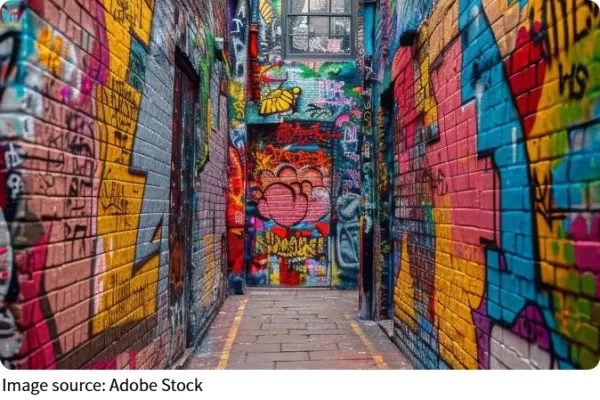
Abstract street artists don't work on blank canvases. They work on concrete, brick, and metal, and those surfaces shape the mood. Rough textures can make colors look deeper and more grounded. Cracks and seams can become part of the composition. Weather, light, and the time of day all change how a piece reads. A wall that glows in morning sun may feel moody and shadowed by evening.
Good abstract artists plan for this. They consider how people will see the work, from what distance, and in what light. The result is art that doesn't just sit on a wall but responds to the place it lives in.
Final Thoughts
Next time you pass an abstract mural, pay attention to how it makes you feel before you try to figure out what it "means." That gut reaction is the art doing its job. Color and form are quiet but powerful tools, and on concrete walls around the world, abstract street artists are using them to shift the mood of entire streets, one wall at a time.
Modern Abstract Geometric Wall Art | Modern Abstract Painting
Video By "LG Craft"